
Patexia Insight 256: Patent Litigation Remains Concentrated in Key U.S. District Courts
U.S. District Court patent litigation continues to be one of the most consequential and data-rich arenas in intellectual property enforcement. Between July 1, 2020, and June 30, 2025, 18,352 patent cases were filed across federal courts, involving tens of thousands of companies, law firms, attorneys, and patents. These disputes influence competitive outcomes, licensing strategies, and often define the boundaries of entire technology markets. Tomorrow, we will release our latest Patent Litigation Intelligence Report, offering a detailed, data-driven look at filings, outcomes, and the courts, firms, and attorneys driving patent litigation today.
Patent litigation in the United States does not spread evenly across the federal court system. While cases are filed nationwide, a relatively small group of district courts continues to handle a disproportionate share of patent disputes. For companies and litigators alike, where a case is filed can influence everything from timing and cost to procedural dynamics and case strategy.
Most Active U.S. District Courts for Patent Litigation
Over time, changes in the law and court procedures have affected how easily litigants can choose their preferred venue. The 2017 U.S. Supreme Court TC Heartland decision limited the ability to file patent cases just anywhere a defendant does business, narrowing the range of possible forums. This shift altered the nationwide distribution of patent cases. At the same time, local rules and procedural innovations in certain districts have made some courts especially attractive. Expedited trial procedures and specialized patent dockets in the Eastern and Western Districts of Texas and the Northern District of California, for example, have drawn both patent holders and defendants seeking more efficient and predictable case management.
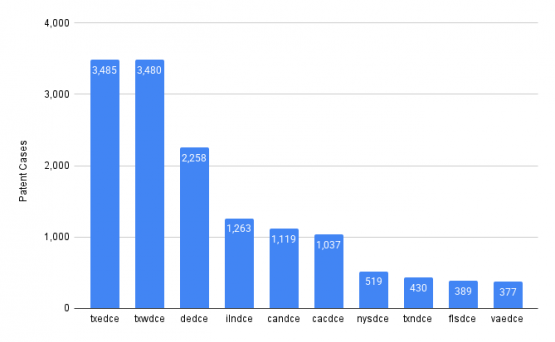
The chart below highlights the ten U.S. district courts with the highest number of patent filings between July 1, 2020, and June 30, 2025, based on data from our upcoming Patent Litigation Intelligence Report.
The Eastern District of Texas (TXEDCE), long favored in patent litigation for its streamlined procedures and historically plaintiff-friendly reputation, remains the busiest court, handling 3,485 cases. The Western District of Texas (TXWDCE) follows closely with 3,480 cases, driven in large part by the high-profile activity under Judge Albright. While recent procedural changes and court orders have begun to influence filing patterns, the Western District continues to attract litigants seeking efficiency and predictability, keeping it among the nation’s top venues for patent disputes.
The District of Delaware (DEDCE), which handled 2,258 cases, has seen a relative decline in patent filings in recent years. This change appears driven more by evolving court practices than by a loss of relevance. In particular, the district’s enhanced disclosure requirements, especially those concerning litigation funding and corporate ownership, have increased transparency obligations for plaintiffs, influencing filing decisions while maintaining Delaware’s status as a key patent venue.
California's Northern District (CANDCE) and Central District (CACDCE) also stand out with 1,119 and 1,037 cases, respectively. Many high-tech companies, startups, and established innovators are headquartered in California, which naturally results in a concentration of intellectual property disputes within its courts. The Northern District of Illinois (ILNDCE), meanwhile, is on the rise, driven in large part by the prevalence of “Schedule A” cases, a litigation mechanism that allows a plaintiff to sue numerous unidentified online sellers in a single complaint under a sealed Schedule A attachment.
What Court-Level Volume Does and Does Not Show
Filing counts provide a useful starting point, but they tell only part of the story. Court activity alone does not reveal how cases progress after filing, how long they remain active, or how often they reach judgment, versus settlement or dismissal. Nor does it show how outcomes differ across courts or which judges, law firms, and attorneys are most closely associated with each venue.
Understanding these dynamics requires a deeper look at case status, termination outcomes, timing, and the parties involved, areas where surface-level filing data quickly reaches its limits. These questions and more are explored in detail in Patexia’s Patent Litigation Intelligence Report. Drawing on six years of comprehensive federal court data, the report offers a thorough analysis of how U.S. patent disputes unfold across district courts, highlighting trends, ranking law firms, attorneys, companies, and analyzing venue-specific patterns.
In the coming weeks, we’ll dive deeper into insights from this report, including the top-performing companies, law firms, and attorneys based on activity and results. Stay tuned!
More insights
Structuring Solar IP Claims for Leverage: How System Claims and Induced or Contributory Infringement Can Expand Enforcement Options
Written by: Tyler S. Cox Key Takeaways: Nextpower’s mix of apparatus and system claims illustrates how claim strategy can expand enforcement flexibility. Additionally, carefully drafting patent claims can expand the scope of protection of the claim…

Litigation Finance Tax Dropped From Trump S Big Beautiful Bill
In a major development for the billion dollar litigation finance industry, a tax provision targeting litigation funders has been removed from President Trump’s sweeping tax and spending legislation, dubbed the “Big, Beautiful Bill”,…

Network-1 Technologies Initiates Patent Litigation Against Samsung Over eSIM and 5G Technology
Network-1 Technologies, Inc. (NYSE: NTIP) , an intellectual property investment and licensing company, has started a patent infringement lawsuit against Samsung Electronics Co., Ltd. and Samsung Electronics America, Inc . The case was filed in the United…