
Litigation Finance Tax Dropped From Trump S Big Beautiful Bill
In a major development for the billion dollar litigation finance industry, a tax provision targeting litigation funders has been removed from President Trump’s sweeping tax and spending legislation, dubbed the “Big, Beautiful Bill”, following a ruling from the Senate on Monday.
The proposal, initially floated by Sen. Thom Tillis (R–NC), aimed to impose a 31.8% tax on profits from litigation funding, a reduction from an earlier version that proposed a 40.8% tax. The Parliamentarian Elizabeth MacDonough's ruling, based on the Byrd Rule governing budget reconciliation, concluded that the provision did not meet the requirements for inclusion under the fast-track legislative process. As a result, the tax was stripped from the bill during the Senate’s round-the-clock “vote-a-rama.”
A Win for Funders
For litigation finance providers, who fund lawsuits in exchange for a portion of any judgment or settlement, this ruling is a significant win. The industry has long argued that such a tax would have had a big impact, with some estimates (such as one by Schulte Roth & Zabel) warning that effective tax rates could have approached 65% once distributions and other obligations were factored in.
Opponents of the tax also argued it would disproportionately benefit large corporations, allowing them to avoid accountability by weakening plaintiffs' access to financial support needed to sustain complex litigation. Funders, including both major players and boutique finance shops, mobilized in recent weeks, deploying lobbyists and building coalitions to counter the provision.
Republican Party Divide and Industry Pressure
The litigation tax also became a source of intra-party tension. While some Republicans opposed the tax, citing concerns about limiting legal recourse for ordinary Americans, others, aligned with major corporations and pro-business groups like the American Tort Reform Association, championed it as a way to bring transparency and restraint to what they view as a rapidly expanding and loosely regulated sector.
A Broader Regulatory Landscape
Although the proposed tax on litigation finance has been struck from the federal reconciliation bill, regulatory scrutiny of the industry is intensifying across the country. A growing number of states including California, Georgia, Delaware, Louisiana, Kansas, Montana, West Virginia, Wisconsin, and Indiana, have introduced or enacted measures aimed at increasing transparency, limiting foreign influence, and establishing oversight mechanisms for litigation funding.
More insights
Structuring Solar IP Claims for Leverage: How System Claims and Induced or Contributory Infringement Can Expand Enforcement Options
Written by: Tyler S. Cox Key Takeaways: Nextpower’s mix of apparatus and system claims illustrates how claim strategy can expand enforcement flexibility. Additionally, carefully drafting patent claims can expand the scope of protection of the claim…
Patexia Insight 256: Patent Litigation Remains Concentrated in Key U.S. District Courts
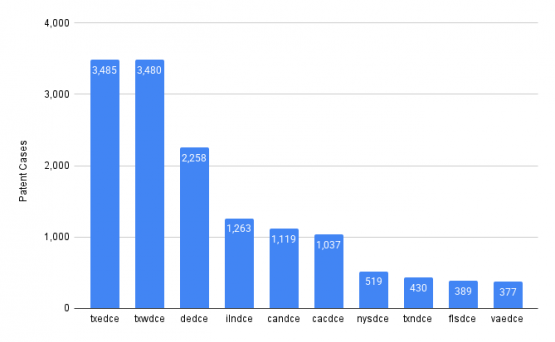
U.S. District Court patent litigation continues to be one of the most consequential and data-rich arenas in intellectual property enforcement. Between July 1, 2020, and June 30, 2025, 18,352 patent cases were filed across federal courts, involving tens of…

Network-1 Technologies Initiates Patent Litigation Against Samsung Over eSIM and 5G Technology
Network-1 Technologies, Inc. (NYSE: NTIP) , an intellectual property investment and licensing company, has started a patent infringement lawsuit against Samsung Electronics Co., Ltd. and Samsung Electronics America, Inc . The case was filed in the United…