
Uspto S Automated Search Pilot Through a Biotech Lens
Contributed by Knobbe Martens. Originally published on Patexia; republished here as part of the LexDana archive.
Written by:Jason J. Jardine and Geetha Durairaj, Ph.D.
In October 2025, the U.S. Patent and Trademark Office (USPTO) launched the “Artificial Intelligence Search Automated Pilot Program,” or ASAP!, an initiative to identify potential prior art using artificial intelligence (AI) tools before a patent application is examined. Original, noncontinuing, nonprovisional utility applications filed under 35 U.S.C. 111(a) on or after October 20, 2025, and on or before April 20, 2026 are eligible to participate in ASAP!. The goal of the Pilot Program is to improve efficiency by giving applicants an early glimpse of potential prior art. Applicants who participate in ASAP! can petition to receive an Automated Search Results Notice (ASRN), which lists up to ten relevant references. While Applicants are not required to respond to ASRN, the search provides the Applicants an early opportunity to identify and address prior art-based rejections and/or make strategic decisions on their filings.
However, the search results of this program may be less nuanced for inventions in certain technologies including life sciences and biotechnology applications. For example, prior art for biotechnology inventions is often embedded in databases, deposited biological material records or datasets including sequence listings or experimental data that may not be fully captured by AI search tools. Furthermore, claims may include functional language, for example how a claimed protein binds to a particular target, the meaning of which hinges on details found in the body of the specification, which an AI model may miss entirely. As a result, the ASRN may overlook important references or over-flag superficially similar art, creating both blind spots and false positives in the biotech space.
Therefore, at this time, for biotech applicants, an ASRN may be useful as a supplementary data point, but is not a substitute for expert human judgment and analysis. As the USPTO gathers feedback from this program and evaluates the alignment between AI-generated results and examiner findings, future programs may incorporate context-aware search algorithms that can seamlessly integrate complex biological databases and datasets for improving search precision.
Editor: Brenden S. Gingrich,Ph.D.
More insights
Does the Uspto Issue Secret Patents on Aerospace Innovations
Written by : Tom Cowan Key Takeaways : Despite periodic mentions by aerospace innovators of “secret patents,” this author is not aware of any evidence of such patents. There may be confusion with “Secrecy Orders,” which apply to…
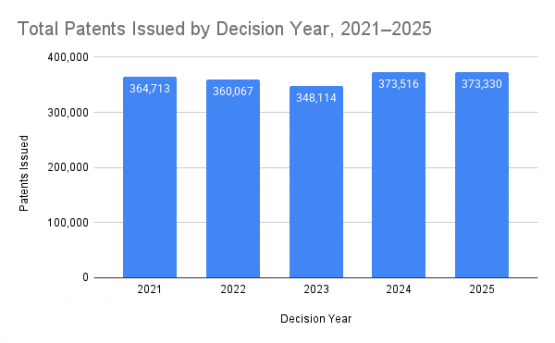
Patexia Patent Insight 20: Patent Issuance Levels Hold Steady Through 2025
Raw numbers often say more than commentary. In patent prosecution, issuance data provides one of the clearest signals of how much innovative activity is actually making its way through the system. Unlike filings, which can reflect short-term strategy…
Life Science Considerations on the Uspto S New Guidelines for Ai Assisted Inventorship
Written by : Robert J. Hilton, Ph.D. and Susan M. Janicki, Ph.D. On November 26, 2025, the United States Patent and Trademark Office (USPTO) issued revised guidelines for determining inventorship of AI-assisted inventions, [1] which is a significant…