
Renewed Efforts in Congress for Pharmaceutical Patent Reform
Contributed by Knobbe Martens. Originally published on Patexia; republished here as part of the LexDana archive.
Written by:Bailey R. Arenberg & Jason J. Jardine
With the recent convocation of the 119th Congress, a change in administration, and resignation of USPTO Director Vidal, pharmaceutical patent reform is likely on the minds of many in Washington. Prior to this political transition, pharmaceutical patent reform garnered renewed attention in the 118th Congress, signaling that legislative efforts in this field remain a priority to those in government. Among the most notable developments were Senate bill 150 (S.150) and House of Representatives bill 6986 (H.R.6986).
S.150, otherwise known as the Affordable Prescriptions for Patients Act of 2023, proposed capping the number of patents a biologic manufacturer can assert in litigation against biosimilar applicants to 20. This measure was aimed at streamlining the patent litigation process under the Biologics Price Competition and Innovation Act (BPCIA).
Originally, S.150 addressed several different practices, including "product hopping," where manufacturers are alleged to only introduce minor changes to a product in order to extend market exclusivity. These provisions, which would have allowed the Federal Trade Commission (FTC) to take legal action against such practices, were ultimately removed from the bill. This deletion narrowed the scope of the bill to biologics litigation, reducing its projected impact. The Congressional Budget Office initially estimated that the original S.150 bill could reduce the federal deficit by $1.8 billion over the next decade, but this figure no longer applied to the revised bill.
Similarly, H.R.6986 proposed a means to limit certain pharmaceutical company practices. Entitled “To address patent thickets,” H.R.6986 aimed to weaken the effects of pharmaceutical patent groups, namely in litigation under the BPCIA or Hatch-Waxman Act. A patent group, also known as a patent family, is a collection of patents covering the same or similar technical content and related to each other through priority claims. Examples of patent groups include parent and divisional applications, as well as patent applications for the same invention filed in multiple countries. H.R.6986 proposed limiting the number of patents per patent group that may be asserted in an action for infringement to only one patent per patent group.
The Senate passed S.150, but both bills ultimately failed to be passed into law at the culmination of the 118th Congress. Despite the failure of these bills to become law, the bipartisan support behind these legislative measures reflects ongoing concerns in Congress about balancing innovation and competition in the pharmaceutical industry. With the 119th Congress sworn in at the beginning of January, it remains unclear whether the new session will continue prioritizing pharmaceutical reform or adopt a different focus.
Editor: Brenden S. Gingrich, Ph.D.
More insights
Does the Uspto Issue Secret Patents on Aerospace Innovations
Written by : Tom Cowan Key Takeaways : Despite periodic mentions by aerospace innovators of “secret patents,” this author is not aware of any evidence of such patents. There may be confusion with “Secrecy Orders,” which apply to…
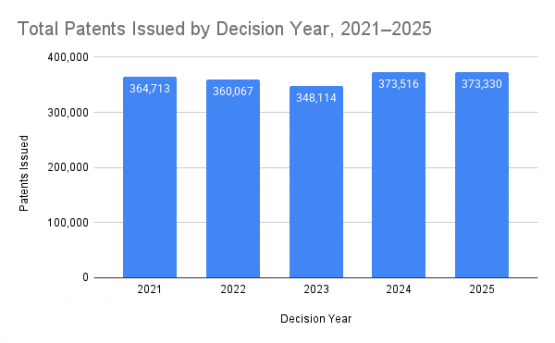
Patexia Patent Insight 20: Patent Issuance Levels Hold Steady Through 2025
Raw numbers often say more than commentary. In patent prosecution, issuance data provides one of the clearest signals of how much innovative activity is actually making its way through the system. Unlike filings, which can reflect short-term strategy…
Life Science Considerations on the Uspto S New Guidelines for Ai Assisted Inventorship
Written by : Robert J. Hilton, Ph.D. and Susan M. Janicki, Ph.D. On November 26, 2025, the United States Patent and Trademark Office (USPTO) issued revised guidelines for determining inventorship of AI-assisted inventions, [1] which is a significant…