
Brookings Institution Report Highlights Green Patent Problems
Contributed by Green Patent Law. Originally published on Patexia; republished here as part of the LexDana archive.
A new report by the Brookings Institution notes a troubling recent reversal in U.S. green patenting activity.
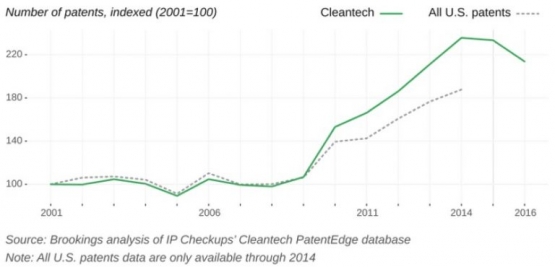
Specifically, the report found that the total number of clean tech patents granted by the U.S. Patent and Trademark Office between 2014 and 2016 declined by nine percent each year. This after a long stretch of growth – thirteen years of patent grants growing at a rate of seven percent annually between 2001 and 2014.
Here’s a graph from the report, based on data from the Cleantech PatentEdge database, run by our friends at IP Checkups:
Entitled “Patenting invention” Clean energy innovation trends and priorities for the Trump administration and Congress,” the report examined patterns in clean tech patenting since 2001, both nationally and by metropolitan area.
According to a Brookings Metro press release, the authors, Devashree Saha and Mark Muro, hope the report’s “baseline look at the pace and geography of cleantech innovation” will inform federal and local decision-making with respect to innovation policy.
The authors highlighted five key findings. First, while green patenting has grown significantly since 2001, it may be slowing now. This trend could be a result of funding declines by the federal government and venture capitalists over the past several years.
Second, green patenting is concentrated in a small group of technologies. In particular, the report identifies advanced green materials, energy efficiency, and transportation (each accounting for 18% of the total) as having higher proportions of patents.
As for geography, the report concludes that green patenting is widely distributed across the United States, but large metropolitan areas are the source of a disproportionate share of the patenting activity. Large and small metro areas show distinctive profiles in green patenting, varying in their specializations, the report found.
Finally, the report found that the share of clean tech patents owned by companies based outside the United States has grown over the years. According to the Executive Summary, this trend reflects the globalization of clean tech industries, particular in Asian economies.
What does this mean for clean tech innovation and green patenting going forward? Saha was quoted by Greentech Media, saying the data “raises concerns about the long-term competitiveness of the U.S. cleantech sector.”
Saha also said that the Trump administration’s plans to cut budgets for clean energy “could make this flattening a more permanent downward trend in the next few years.”
Muro commented on Trump’s budget proposal that would eliminate certain programs such as ARPA-E, the U.S. government’s energy innovation program, noting that “[t]here are critical [federal] programs that have major impacts on these industries and ecosystems.”
The report warns against the U.S. falling behind in clean tech innovation:
Given the size of the global clean energy economic opportunity, the United States can ill afford to relinquish its lead on innovation in the burgeoning global cleantech market to China or other countries.
The authors recommend that the U.S. maintain clean energy R&D appropriations at viable levels, maximize the impact of the national energy labs, preserve ARPA-E, and maintain and scale up U.S. energy innovation hubs.
This article was originally published on Eric's Green Patent Blog.
More insights
Does the Uspto Issue Secret Patents on Aerospace Innovations
Written by : Tom Cowan Key Takeaways : Despite periodic mentions by aerospace innovators of “secret patents,” this author is not aware of any evidence of such patents. There may be confusion with “Secrecy Orders,” which apply to…
Patexia Patent Insight 20: Patent Issuance Levels Hold Steady Through 2025
Raw numbers often say more than commentary. In patent prosecution, issuance data provides one of the clearest signals of how much innovative activity is actually making its way through the system. Unlike filings, which can reflect short-term strategy…
Life Science Considerations on the Uspto S New Guidelines for Ai Assisted Inventorship
Written by : Robert J. Hilton, Ph.D. and Susan M. Janicki, Ph.D. On November 26, 2025, the United States Patent and Trademark Office (USPTO) issued revised guidelines for determining inventorship of AI-assisted inventions, [1] which is a significant…