
101 Patent Reform Progressing in Congress
Contributed by Knobbe Martens. Originally published on Patexia; republished here as part of the LexDana archive.
Written by: Bridget A. Smith & Philip M. Nelson
On May 22, 2019, a bipartisan committee of the U.S. Senate and House released a draft bill on § 101 reform, in a further attempt to reduce procedural obstacles for patent applicants.
The draft bill would change the existing statutory language of 35 U.S.C. § 101 as shown here:
Whoever invents or discovers any new and useful process, machine, manufacture, or composition of matter, or any new and useful improvement thereof, may obtain a patent therefor, subject to the conditions and requirements of this title.
Without the word “new,” this proposal would remove ambiguity by separating the question of novelty from the distinct question of subject matter eligibility. The draft bill adds a definition of “useful” to 35 U.S.C. § 100:
The term “useful” means any invention or discovery that provides specific and practical utility in any field of technology through human intervention.
Aspects of this definition could give rise to significant controversy and litigation if not clarified further. “Specific and practical utility” seems similar to a standard currently being applied by the USPTO under its recent Updated Guidance. However, “field of technology” and “through human intervention” both seem similar to European standards for patent eligibility and could be used to limit patents on business and medical method claims, for example (notwithstanding their value and novelty). Given competing interests, however, any ultimate legislation will most likely leave it to the courts to interpret these phrases.
The draft bill would require patent eligibility to be evaluated only “while considering the claimed invention as a whole, without discounting or disregarding any claim limitation.” This would not be a major change.
The Committee further proposes “Additional Legislative Provisions”:
- The provisions of section 101 shall be construed in favor of eligibility.
- No implicit or other judicially created exceptions to subject matter eligibility, including ‘abstract ideas’, laws of nature’ or ‘natural phenomena’ shall be used to determine patent eligibility under Section 101, and all cases establishing or interpreting those exceptions to eligibility are hereby abrogated.
- The eligibility of a claimed invention under section 101 shall be determined without regard to: the manner in which the claimed invention was made; whether individual limitations of a claim are well known, conventional or routine; the state of the art of the art at the time of the invention; or any other considerations relating to sections 102, 103, or 112 of this title.
This committee’s proposed outline, released last month, had attempted to define categories that should not be eligible for patenting. The draft bill abandons this attempt.
The committee continues to solicit feedback. Senate hearings on the topic will be held on June 4, 5, and 11. The hearings will feature three panels of five witnesses each, for a total of 45 witnesses over three days. The Senate hearings should be a bellwether of the final legislation. Whereas the proposed outline garnered some criticism, early feedback on the draft bill appears to be overwhelmingly positive from supporters of the U.S. patent system.
Editor: Philip M. Nelson
More insights
Does the Uspto Issue Secret Patents on Aerospace Innovations
Written by : Tom Cowan Key Takeaways : Despite periodic mentions by aerospace innovators of “secret patents,” this author is not aware of any evidence of such patents. There may be confusion with “Secrecy Orders,” which apply to…
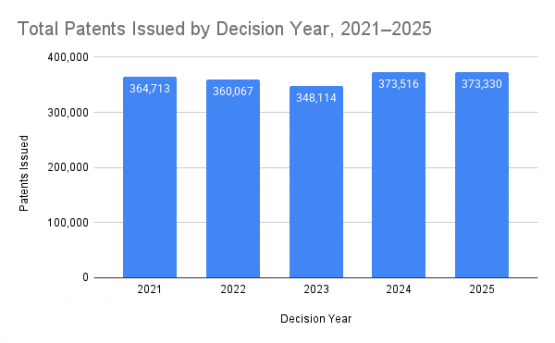
Patexia Patent Insight 20: Patent Issuance Levels Hold Steady Through 2025
Raw numbers often say more than commentary. In patent prosecution, issuance data provides one of the clearest signals of how much innovative activity is actually making its way through the system. Unlike filings, which can reflect short-term strategy…
Life Science Considerations on the Uspto S New Guidelines for Ai Assisted Inventorship
Written by : Robert J. Hilton, Ph.D. and Susan M. Janicki, Ph.D. On November 26, 2025, the United States Patent and Trademark Office (USPTO) issued revised guidelines for determining inventorship of AI-assisted inventions, [1] which is a significant…