
The Solar IP Landscape in the u.s. And China Is Heating Up
Contributed by Knobbe Martens. Originally published on Patexia; republished here as part of the LexDana archive.
Written by: Michael E. Salamy
Key Takeaway: Recent developments in the U.S. and China highlight that strong patent strategy and IP risk management are critical for companies operating in the solar supply chain.
In March 2026, the U.S. International Trade Commission (ITC) launched a section 337 investigation into imports of tunnel oxide passivated contact (TOPCon) solar products in the U.S., following a complaint by First Solar, one of the largest U.S. solar manufacturers. The investigation identifies 47 respondents from 11 countries, including China’s largest solar manufacturers. First Solar requested that the ITC issue a general exclusion order, or in the alternative, a limited exclusion order and cease and desist orders, which could significantly restrict imports of accused products into the U.S. The full list of respondents can be found here.
Meanwhile, in April 2026, China’s three largest solar manufacturers, Trina Solar, JA Solar, and JinkoSolar, formally launched China’s first solar patent pool under the guidance of the Ministry of Industry and Information Technology (MIIT) and the China National Intellectual Property Administration (CNIPA). The patent pool includes 54 TOPCon patents and patent applications, and reportedly aims to “curb excessive domestic competition and to support Chinese [solar] companies in expanding more effectively into international markets,” per IPFray.
TOPCon is a next-generation solar cell architecture. Compared to older technologies such as passivated emitter and rear contact (“PERC”) cells, TOPCon solar panels generally offer higher conversion efficiency, lower long-term degradation, and improved performance in high-temperature environments.
These developments highlight the increasing importance of strong intellectual property protection and strategy in the solar industry. Companies operating in the solar supply chain should consider:
- • conducting freedom-to-operate analyses before launching or importing products;
- • evaluating exposure to Section 337 investigations and other trade-related IP actions;
- • reviewing agreements for indemnification and licensing protections;
- • monitoring developments in foreign patent pools; and
- • developing U.S. and international patent filing strategies.
More insights
Fresh From the Bench: Latest Precedential Patent Cases
CASE OF THE WEEK Actelion Pharms. Ltd. v. Mylan Pharms. Inc. , Appeal No. 2024-1641 (Fed. Cir. May 13, 2026) In our Case of the Week, the Federal Circuit affirmed a judgment that Mylar’s proposed generic hypertension drug would not infringe patents…
Fresh From the Bench: Latest Precedential Patent Cases
CASE OF THE WEEK Apple Inc. v. ITC , Appeal No. 2024-1285 (Fed. Cir. Mar. 19, 2026) In our Case of the Week, the Federal Circuit upheld a major ruling from the International Trade Commission against Apple Inc. in its patent dispute with Masimo Corporation,…
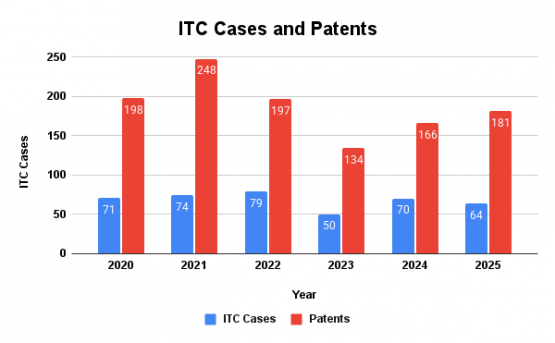
Patexia Insight 260: Tracking the Trends of ITC Investigations in 2025
The latest ITC Section 337 Investigation Intelligence 2026 report is set to be released tomorrow, providing a comprehensive look at the trends and dynamics of U.S. International Trade Commission investigations. Drawing on data from ITC filings, EDIS…