
PTAB Revisited: Avoiding Federal Circuit Remands
Contributed by Ropes & Gray. Originally published on Patexia; republished here as part of the LexDana archive.
Remand or Reversal?
Appeals from the Patent Trial & Appeal Board (PTAB) have now become a major component of the Federal Circuit’s docket. Given the deferential “substantial evidence” standard accorded PTAB decisions, upward of 60% of such appeals are simply affirmed — many without further comment. The remainder of PTAB appeals include a mixed bag of partial affirmances, reversal and/or remands. While both reversal and remand outcomes are appellate “wins” for Patent Owners, a remand for a Patent Owner is often a winning of the Federal Circuit appeal battle only to lose the PTAB war.
When a case is remanded to the PTAB, a second decision is targeted to issue within six months time. In some instances further briefing is authorized, but in many cases it is not. Further, it is exceedingly rare for a second oral hearing to be conducted.
In these scenarios, Patent Owners may find themselves facing a second, adverse PTAB decision on largely the same record.
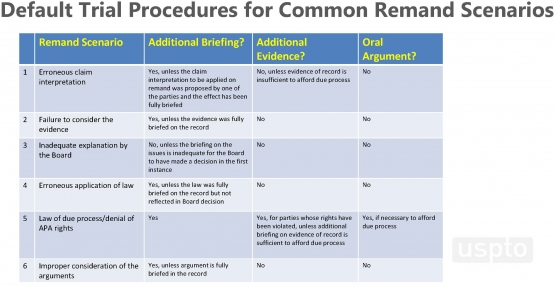
PTAB presentation materials (below) outline the most common remand scenarios for AIA trial proceedings:
Generally speaking, the difference in a remand and reversal is whether or not the Federal Circuit can reach a decision on the ultimate issue of patentability absent further development of the factual record. As such, it is especially critical for Patent Owners to develop a robust PTAB record on subsidiary factual issues on such matters as obviousness and claim construction. And to frame the issues on appeal in a manner that will allow the Court to reverse rather than remand. That is, focusing appellate issues independent of the need for further fact finding.
Of course, there are scenarios in which remand cannot be avoided. But in many cases, there are choices to be made in selecting issues for appeal, and opportunities for Patent Owner’s to enter evidence into the record in anticipation of appellate battles stemming from the Patent Owner’s response strategy. Patent Owner’s would be wise to consider such issues during trial, otherwise, they may just win themselves a second loss by way of appeal.
Scott A. McKeown is an author of the Patents Post Grant.
More insights
Fresh From the Bench: Latest Precedential Patent Case
Ridge Corp. et al. v. Kirk NationaLease Co. et al. , Appeal No. 2025-1254 (Fed. Cir. July 13, 2026) In its only precedential patent opinion last week, the Federal Circuit considered an appeal of a preliminary injunction issued by the U.S. District Court…
Fresh From the Bench: Latest Precedential Patent Cases
CASE OF THE WEEK Wyeth LLC v. AstraZeneca Pharmaceuticals LP , Appeal No. 2024-2325 (Fed. Cir. July 9, 2026) In our Case of the Week, the Federal Circuit affirmed a district court ruling reversing a $107.5 million jury verdict against AstraZeneca in a case…
Enanta Pharmaceuticals, Inc. v. Pfizer Inc., Appeal No. 2025-1427 (Fed. Cir. Jun. 23, 2026)
CASE OF THE WEEK Enanta Pharmaceuticals, Inc. v. Pfizer Inc., Appeal No. 2025-1427 (Fed. Cir. Jun. 23, 2026) In our Case of the Week, the Federal Circuit affirmed summary judgment invalidating all claims of Enanta’s Patent No. 11,358,953 as…