
Migraine Drug: Eli Lilly's Landmark Overturn Victory in Patent Battle

In a groundbreaking legal development, Eli Lilly has secured a remarkable victory in a high-stakes patent battle that has sent shockwaves through the migraine drug market. The verdict, delivered by a Massachusetts federal judge, overturns a staggering $176.5 million jury ruling against Eli Lilly, which had been accused of infringing on Teva Pharmaceutical's patent for the migraine drug Ajovy. This landmark decision not only marks a rare reversal of a jury verdict but also holds profound implications for the intellectual property landscape within the pharmaceutical industry.
The Verdict Reversed:
In a legal twist, U.S. District Judge Allison Burroughs has ruled in favor of Eli Lilly, stating that Teva's patents related to the use of antibodies to inhibit headache-causing peptides were invalid. This decision challenges the notion that Teva had the exclusive right to patent calcitonin gene-related peptides (CGRPs) as a treatment for migraines. The verdict hinges on the argument that Eli Lilly's migraine drug, Emgality, utilizes a distinct mechanism of action and antibody composition, making it substantially different from Teva's Ajovy.
Industry Impact:
This extraordinary legal battle reflects the fierce competition within the migraine drug market. Both Emgality and Ajovy entered the market in close succession, vying for dominance in the treatment of migraine headaches by targeting CGRPs. Eli Lilly's victory not only reaffirms its position but also questions the validity of broad-ranging patents that seek to encompass entire classes of drugs. With Emgality's sales soaring past $650 million globally last year, this ruling is poised to reshape the dynamics of the industry.
The Road Ahead:
As the dust settles on this monumental legal clash, Eli Lilly stands at the forefront of the migraine drug market. Emgality's success is set to continue its upward trajectory, with sales expected to reach $1.3 billion by 2029. This victory underscores the importance of challenging broad patent claims and protecting intellectual property rights within the pharmaceutical landscape.
Eli Lilly's triumph in this patent battle is not just a legal victory; it's a testament to the dynamic nature of the pharmaceutical industry. As the landscape evolves and innovators clash over intellectual property, this landmark decision serves as a reminder of the critical role that legal battles play in shaping the future of medicine.
Eli Lilly is represented by Andrea L. Martin of Burns & Levinson LLP and Charles E. Lipsey, Ryan O'Quinn, Emily R. Gabranski, Marta Garcia Daneshvar, William B. Raich, Danielle A. Duszczyszyn, Denise Main, Pier D. DeRoo, Matthew Luneack, Yoonjin Lee, Sydney R. Kestle and J. Michael Jakes of Finnegan Henderson Farabow Garrett & Dunner LLP.
More insights
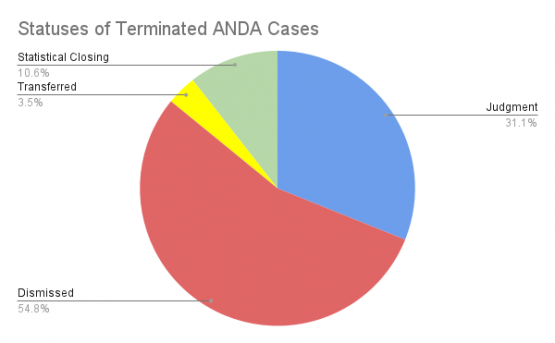
Patexia Insight 254: Rankings of Leading ANDA Litigation Attorneys
ANDA litigation remains one of the most demanding areas of patent law, where outcomes often hinge on the experience and judgment of individual attorneys. In disputes that determine when a generic drug can enter the market, the role of lead counsel is…
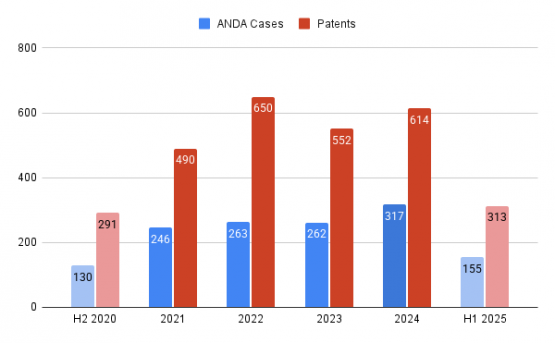
Patexia Insight 246: What the Latest Data Reveals About ANDA Litigation Trends
Abbreviated New Drug Application (ANDA) litigation remains one of pharma’s most contested arenas. With market exclusivity and billions in annual sales on the line, each case influences competition, pricing, and the speed at which patients see…
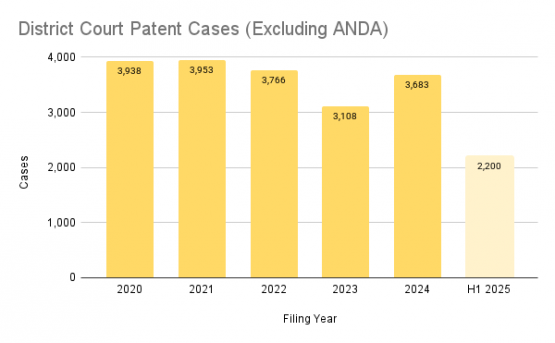
Patexia Insight 243: Patent Litigation Trends and Insights from the First Half of 2025
Over the past several years, patent litigation has gone through its share of ups and downs. Shifting legal standards, evolving strategies by patent owners and defendants, and broader economic factors have all played a role in defining the volume and nature…