
Bipartisan Law Introduced to Clarify Patent Eligibility
Contributed by Knobbe Martens. Originally published on Patexia; republished here as part of the LexDana archive.
Written by: Eric L. Abada
For the past decade, controversy regarding the laws of patent eligibility has created uncertainty in the minds of inventors and investors, especially in the biotechnology, medical diagnostics, and software industries adjacent to and often intertwined with medical devices. Congress is trying to help.
On May 1, 2025, the Patent Eligibility Restoration Act (PERA) was introduced in both the U.S. Senate and the U.S. House of Representatives, sponsored by Senators Thom Tillis (R-NC) and Chris Coons (D-DE) and Representatives Kevin Kiley (R-CA) and Scott Peters (D-CA). PERA is a proposed amendment to the statute 35 U.S.C. 101 (Section 101), which governs patent eligibility. The goals and intended balance of this proposed legislation were summarized in a press release from Senator Tillis: “This bipartisan, bicameral legislation maintains the existing statutory categories of eligible subject matter, which have worked well for over two centuries, while addressing inappropriate judicially created eligibility limitations by creating clear rules for what is eligible.”
Why Reform Patent Eligibility Laws?
In the early 2010s, the U.S. Supreme Court issued a series of decisions providing the Alice/Mayo framework that relies on so-called “judicial exceptions” to the default under Section 101 of the patent laws that man-made concepts are eligible subject matter for patents. Those “exceptions”–areas not eligible for patenting–included: abstract ideas, laws of nature, and natural phenomena (including products of nature). PERA states that the judicially created Alice/Mayo framework and exceptions “have led to extensive confusion and a lack of consistency” and that Section 101 “is extremely confusing and difficult to discern and apply with any confidence.” See PERA at § 2(3)-(4). Moreover, PERA recites that the judicially created exceptions have led to “an increasing number of inventions [being] ineligible for patent protection.” See id. at § 2(2).
Members of Congress view this as an opportunity to clarify the laws of patent eligibility by amending 35 U.S.C. Section 101, the relevant patent statute.
What Is in the Proposed PERA?
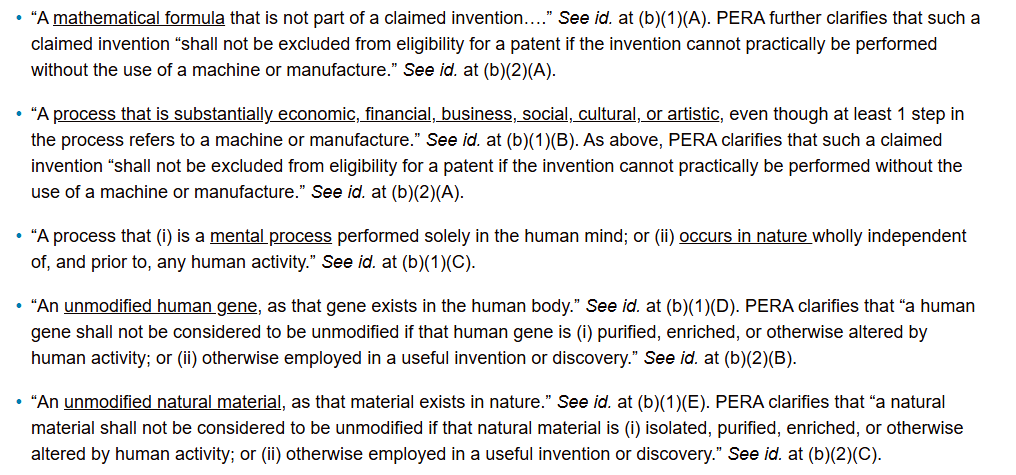
PERA seeks to clarify patent eligibility law by expressly eliminating and replacing “all judicial exceptions to patent eligibility.” See id. at § 2(5)(A),(D). Specifically, the proposed language of Section 101 would recite that otherwise eligible subject matter would be “subject only to the exclusions in subsection (b),” which recites five express exceptions to patent eligibility. See PERA at Proposed Statutory Amendment §101(a)-(b).
PERA’s exceptions to patent eligibility are these:
Additionally, PERA forbids judges from implementing currently-used eligibility tests that have been criticized as extending beyond the realm of eligibility into other patent doctrines, such as novelty and obviousness. Specifically, PERA states that “[patent] eligibility shall be determined … without regard to” the following:

While this proposed legislation has merely been introduced and is not the law at this time, it is still helpful to understand the ongoing dialogue between the federal courts and Congress regarding patent law.
More insights
Changes to Mexican Patent Law May Impact Life Science Patent Prosecution
Written by : Jason J. Jardine and Bailey R. Arenberg Key Takeaway : While recent amendments to Mexico’s patent laws promote faster prosecution and earlier decisions on patents, concerns abound as to the feasibility and integrity of the prosecution…
Why USPTO Rejected Your Patent Application?
You spent months perfecting your invention. Weeks writing the application. But the rejection letter arrived anyway. The culprit? Often, it's something surprisingly simple: your drawings. After reviewing thousands of patent applications, I've…
The Uspto S Evolving Approach to Patent Eligibility Insights From Director Squires Aipla Address
Written by : Philip M. Nelson On October 31, 2025, Director Squires spoke to the American Intellectual Property Law Association and provided a forceful statement on his view for the direction of patent law. Of particular interest were his comments on…